
FEEL THE MEDITERRANEAN
COASTEERING
AT CATALONIA ADVENTURES
GIFT OF ADVENTURES
COASTEERING IN CATALONIA: Guided Adventure
Coasteering Between Rock and Sea
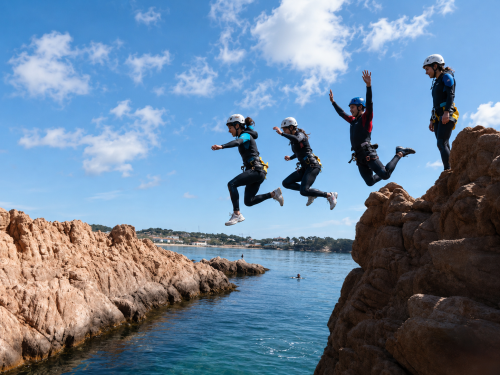
Coasteering in Catalonia is one of the most complete ways to discover the Mediterranean coastline from a completely different perspective. Instead of simply admiring the cliffs from a beach or walking along the coast on a trail, coasteering takes you directly to the point where rock and sea meet, combining progression along cliffs, swimming, easy climbing sections, jumps into the water and exploration of hidden coastal corners.
It is a dynamic activity in which the landscape itself defines the route. Within just a few metres, you may go from moving across a rocky platform to swimming beside a cliff, passing between rocks or discovering a small hidden cove from the water.
At Catalonia Adventures, we carry out our coasteering activities in two of the most interesting coastal environments in Catalonia: Sitges and the Costa Brava. Two areas with very different landscapes, but with one thing in common: a rocky coastline that allows you to experience the Mediterranean in a much more intense way.
Coasteering combines different techniques for progressing over rock and through water and, depending on the itinerary, may include swimming, scrambling, jumps, passages through caves or simple rope manoeuvres.
Coasteering Services in Catalonia
-
Coasteering on the Costa Brava
50,00 € -
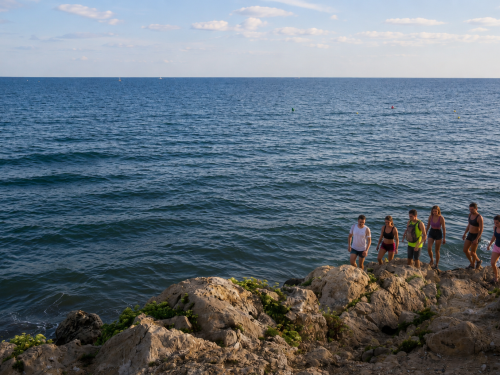
Coasteering in Sitges
50,00 €
Coasteering in Catalonia with Catalonia Adventures:
With More Than 29 Years of Experience Guiding Between Rock and Water
Practising Coasteering in Catalonia is not simply about finding a high rock and jumping into the sea. A well-planned route requires knowledge of the terrain, an understanding of sea conditions and the ability to adapt the progression to the characteristics of the group.
Sea conditions, waves, wind, the characteristics of each water entry point and the condition of the rock can completely change a coastal route. That is why, both before and during a coasteering activity, the guide’s decisions play a fundamental role.
The philosophy of Catalonia Adventures is to approach the activity as a guided experience in nature, seeking a balance between adventure, fun, safety and discovery of the environment.
Our team is made up of qualified sports technicians and professionals specialised in mountain sports and adventure activities. Catalonia Adventures also has extensive experience in the sector, with more than 29 years dedicated to guided activities in natural environments.
Reviews of Activities with Catalonia Adventures




Coasteering Routes in Catalonia: Sitges and Costa Brava:
Extreme Adventure Between the Sea and the Rocks of the Catalan Coast
Catalonia has an enormously varied coastline. For our Coasteering Routes in Catalonia, we mainly operate in two areas: Sitges, on the Garraf coast, and different locations along the Costa Brava. The choice of area and route should be made taking into account the characteristics of the participants and, especially, the actual sea conditions.
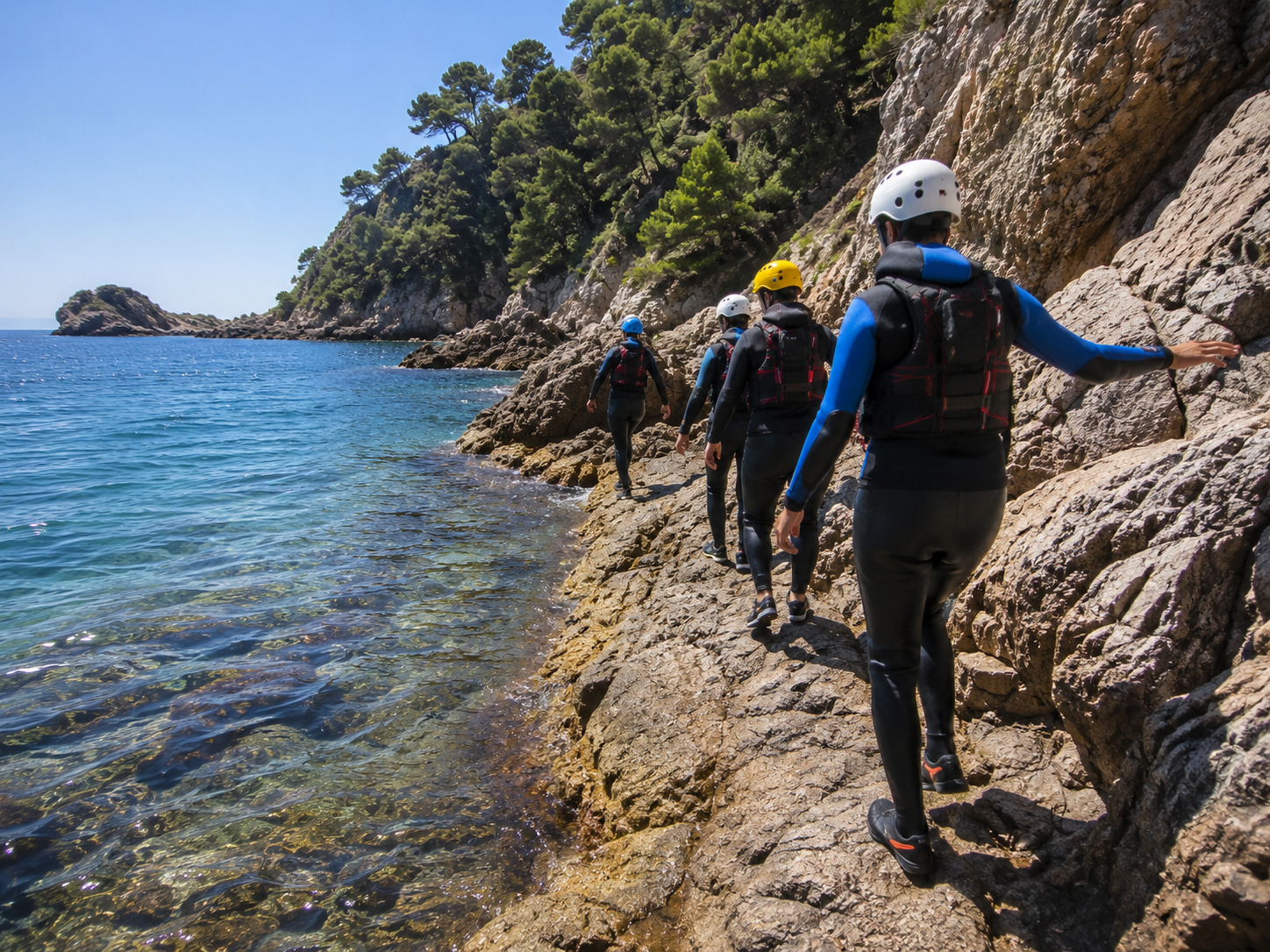
Sitges offers the chance to discover a very different side of the coastline near Barcelona. Beyond its well-known beaches, the coastal environment of the Garraf features areas where limestone cliffs meet the Mediterranean directly, creating cliffs, small sea inlets and formations shaped over thousands of years by the action of the water.
The Garraf Park itself describes its coastline as a landscape of steep cliffs and limestone shaped by the sea, a particularly characteristic feature of this part of Catalonia. This type of terrain makes the Sitges area especially interesting for coasteering, as it allows you to combine progression over rocky ground with different aquatic sections.
It is not simply about getting from one point to another. Part of the experience lies precisely in discovering how the landscape changes when viewed from sea level.
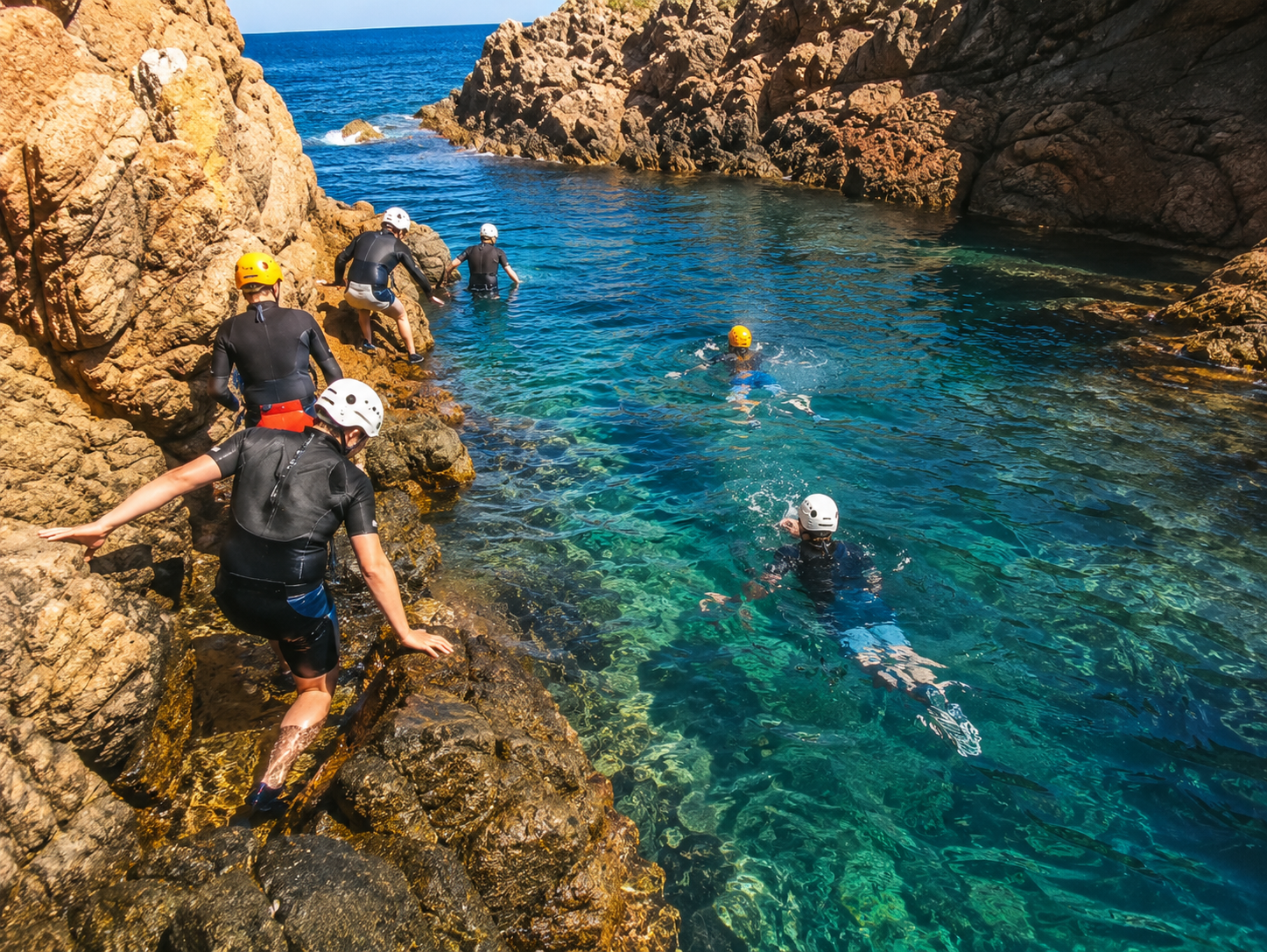
The Costa Brava is one of the great natural settings for water and adventure activities in Catalonia.
Its coastline combines beaches, coves, rocky walls, caves and cliff sections. The official Costa Brava Girona tourism organisation highlights its cliffs, caves and hidden coves as some of the characteristic features of the area when viewed from the sea. Here, coasteering takes on a particularly adventurous character.
The route allows you to progress along that natural boundary where the land ends and the Mediterranean begins. Depending on the selected section, you may encounter swimming areas, rocky passages, easy climbing sections, natural water entries or places that can only be seen from the sea.
The spectacular nature of the landscape does not mean that the activity has to become a competition to make the highest jump. The objective is to create a coherent progression and enjoy the route as a whole.
The sea is part of the route
On a conventional trail, path conditions are usually relatively predictable. In coasteering, there is an additional element: the sea is alive.
Waves, wind and sea conditions can change the way certain sections need to be approached. Assessing these variables beforehand is part of the recognised safety practices for this activity. This is precisely one of the reasons why completing a route accompanied by professionals offers much more than simply knowing the way.
Frequently Asked Questions About Coasteering in Catalonia
What is Coasteering?
Coasteering is an adventure activity that involves progressing along a rocky stretch of coastline by combining different land- and water-based techniques. A route may include walking over rocks, climbing, swimming, traversing alongside cliffs, entering the water by jumping and exploring small caves or coastal formations. Depending on the itinerary, ropes may also be used to overcome certain obstacles. Its main difference from other activities is that it uses the area between the sea and the coastline itself as the terrain for progression.
Do I need previous experience to practise coasteering?
Not necessarily. There are routes with different characteristics, and some can be suitable for beginners provided they are properly adapted to the participants’ level. The important thing is to provide information in advance about your experience, physical condition and any circumstances that could influence the activity. Based on this information and the environmental conditions, an appropriate progression can be selected. Different specialist operators also offer routes designed for people trying coasteering for the first time.
Do you need to know how to swim to do Coasteering in Catalonia?
Coasteering usually includes sections of progression in the sea, so each participant’s swimming ability and confidence in the water are important aspects that should be communicated before taking part in the activity. Some coasteering operators in Catalonia explicitly require participants to know how to swim. Before booking, we recommend informing Catalonia Adventures of any difficulties or lack of confidence in the water so that the suitability of the activity can be properly assessed.
Is it mandatory to do all the jumps?
Coasteering is much more than jumping from a rock. Jumps are only one of the possible manoeuvres that may be included in a route. The priority should be to progress according to the itinerary, the actual sea conditions and the guide’s instructions. Depending on the location, there may be sections of varying difficulty or alternative ways to progress. For this reason, the aim is not to make the highest jump, but to enjoy the overall experience in a controlled way that is adapted to each participant.
What equipment is used for coasteering?
The usual equipment includes a wetsuit, helmet, buoyancy aid and suitable footwear for moving over wet rock. Depending on the characteristics of the route, additional technical equipment may also be used. Specialist safety recommendations consider a wetsuit, helmet, flotation device and stable footwear to be part of the basic equipment for coasteering. Catalonia Adventures will inform you before the activity about the specific equipment required for the selected route.
What happens if the sea conditions are not suitable for the route?
Sea conditions are one of the key factors in any coasteering activity. Waves, wind, weather and the specific conditions of the route must be assessed before and during the activity. Good-practice guidelines for this discipline specifically recommend evaluating these variables as part of safety planning. If the conditions in a particular area are not suitable, the priority should be to modify the plan, choose a viable alternative or follow the instructions established by the professional responsible for the activity.
Coasteering as an Introduction to Adventure Sports
Not all coasteering activities have the same level of difficulty.
Choosing the right route is essential so that someone trying this activity for the first time can enjoy it without facing sections that do not match their level of experience. Other specialist operators in Catalonia also offer beginner-level routes and highlight adapting coasteering to the participants’ level as one of the key aspects of the activity.
Before taking part in an outing, it is important to communicate any physical limitations or relevant circumstances that could affect the development of the activity. Catalonia Adventures also establishes this requirement for prior communication within its safety conditions.
WHAT DOES THE COASTEERING ACTIVITY INVOLVE?
Safety in Coasteering Activities
The marine environment deserves respect.
An area that looks simple from the coast can behave very differently when waves, wind or sea conditions change. That is why a guided activity begins long before entering the water: the route must be assessed and a decision made as to whether the conditions are suitable.
The guide makes decisions on site.
In activities carried out in a constantly changing environment, following a rigid plan would make little sense. A professional must be able to modify a section, find an alternative or avoid a particular area if the actual conditions are not suitable.
AT SEA, KNOWING WHEN TO TURN BACK IS PART OF SAFETY
A good activity is not measured by whether every planned manoeuvre has been completed, but by whether the right decisions have been made throughout the entire route.
The weather, waves and the group’s behaviour are all part of this continuous assessment.
The best coasteering routes in Catalonia are waiting for you, and we are here to guide you safely towards your next adventure.
Our Trusted Brands


