
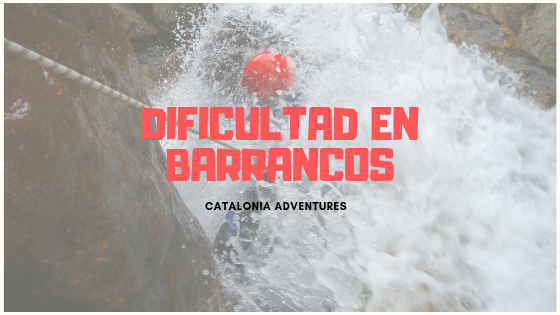

To understand what CANYONING is, one of the key aspects is knowing the difficulties we may encounter during the activity. Therefore, understanding the difficulty grading will help us better understand this sport. The difficulty of a canyon is divided into 3 parts: its vertical character (V), its aquatic character (a), and its commitment level (from I to VI), which refers to the complexity of the descent. For both V and a, a number from 1 to 7 will be shown next to the letter, indicating the magnitude of each parameter. At Catalonia Adventures, we recommend TRAINING so that you can safely manage all the risks described below and practise this sport as safely as possible.
PARAMETERS USED TO DEFINE THE DIFFICULTY OF A CANYON
| VERTICALITY | FROM 1 TO 7 |
| WATER FLOW | FROM 1 TO 7 |
| COMMITMENT | FROM I TO VI |
- Example: V3 a5 V (verticality level 3, with a fairly high water flow and a relatively high level of commitment)
To better understand the commitment level of a canyon, below you will find a table explaining each grade within this parameter:
| COMMITMENT | CRITERIA |
| I | - Possibility of reaching a safe place in the event of a sudden rise in water level - Escape routes throughout the canyon - Route lasting less than 2 hours |
| II | - Possibility of escaping in the event of a sudden rise in water level within 15 minutes of progression - Escape routes within 30 minutes - Route duration from 2 to 4 hours |
| III | - Possibility of escaping in the event of a sudden rise in water level within 30 minutes of progression - Escape routes within 1 hour - Route duration from 4 to 8 hours |
| IV | - Possibility of escaping in the event of a sudden rise in water level within 60 minutes of progression - Escape routes within a maximum of 2 hours - Route duration from 8 hours to 1 day |
| V | - Possibility of escaping in the event of a sudden rise in water level within 2 hours of progression - Escape routes within a maximum of 4 hours - Route duration from 1 to 2 days |
| VI | - Possibility of escaping in the event of a sudden rise in water level after more than 2 hours of progression - Escape routes requiring more than 4 hours - Route duration of more than 2 days |
To help us understand what each grading level represents, a table was created defining every grade. Below, you will find these tables so that you can interpret the difficulty of each canyon yourself.
| DIFFICULTY | VERTICALITY | WATER FLOW |
| 1 VERY EASY |
- No rappels - No climbing or downclimbing |
- No water or calm water |
| 2 EASY |
- Rappels of up to 10 metres with easy access - Easy climbing sections with no significant exposure |
- Swimming in calm water for less than 10 metres - Easy jumps of up to 3 metres - Short slides |
| 3 SLIGHTLY DIFFICULT |
- Vertical sections with low water flow - Low-exposure 3c climbing sections that may require protection - Rappels of less than 30 metres - Slippery, unstable and rugged progression |
- Swimming in calm water for less than 30 metres - Easy jumps from 3 to 5 metres - Long slides |
| 4 FAIRLY DIFFICULT |
- Vertical sections with low water flow, although the flow begins to influence the descent - Rappels with difficult access and/or longer than 30 metres - Consecutive rappels with comfortable belay stations - 4c climbing sections - Rappels with landing areas that are not visible or where the exit requires swimming |
- Prolonged periods in water with loss of body temperature - Moderate water flow - Easy jumps from 5 to 8 metres - Siphons shorter than 1 metre - Long, steep slides |
| 5 DIFFICULT |
- Vertical sections with strong water flow requiring careful trajectory management - Consecutive rappels on walls and hanging belay stations - Exiting pools during the descent - Slippery downclimbing sections - Difficult rope retrieval - Exposed 5c climbing sections |
- Prolonged periods in water with loss of body temperature - Swimming in strong currents - Easy jumps from 8 to 10 metres - Difficult jumps from 5 to 8 metres - Siphons up to 3 metres long |
| 6 VERY DIFFICULT |
- Vertical sections with very strong water flow - Continuous waterfalls requiring difficult and precise progression with careful trajectory control - Delicate belay station installation on natural anchors - Difficult access to and exits from rappels - 6a or A2 climbing sections - Slippery and/or unstable downclimbing sections - Highly turbulent landing pools with powerful moving water |
- Prolonged periods in water with loss of body temperature - Swimming in strong currents and water movements that may cause entrapment hazards (undercuts, hydraulics, etc.) - Easy jumps from 10 to 14 metres - Difficult jumps from 8 to 10 metres - Siphons up to 3 metres long - Technical siphons |
| 7 EXTREMELY DIFFICULT |
- Vertical sections with extremely strong water flow - Very continuous waterfalls requiring extremely difficult and precise progression with careful trajectory control - Delicate belay station installation on natural anchors - Difficult access to and exits from rappels - Poor visibility and frequent obstacles - Climbing sections above 6a or A2 - Slippery and/or unstable downclimbing sections - Highly turbulent landing pools with powerful moving water - Underwater breath-hold sections |
- Prolonged periods in water with loss of body temperature - Swimming in very strong currents and water movements that may cause entrapment hazards (undercuts, hydraulics, etc.) - Easy jumps of more than 14 metres - Difficult jumps of more than 10 metres - Siphons up to 3 metres long - Technical siphons with poor visibility and/or strong currents |
0 Comments